Showing posts with label product review. Show all posts

Tuesday, April 7, 2015

"Ball Blue Book Guide to Preserving"

Image credit: Target.com
I started canning during the summer of 2013. I want to save money, have the freshest possible food, and minimize the number of artificial ingredients, like most people. I got advice from friends and family, researched the Web, and watched YouTube videos. I thought that was plenty of research and successfully canned tomatoes and salsa. I also made some jams and jellies. So far so good but there was an issue. I live in a Denver suburb and have to make altitude adjustments to processing times. Different online recipes gave different adjustments to the times even for tomatoes. 

There was only one solution-the "Ball Blue Book Guide to Preserving," first published in 1909. Right there on page 5 are the altitude adjustments. The recipe I had for canning red cabbage called for 4 quarts of red cabbage, not the weight or number of heads. The answer is in the equivalents table on page 117-just use the dry measure conversion of cups to quarts. The table even has the measurements for a bushel and a peck! 

Introduction 

The first chapter warmly invites you with the title “Learning About Canning, just one step beyond cooking.” I was afraid of canning due to the fear of spoiled food or worse. This chapter allayed these fears by an easily understandable and thorough explanation of what causes spoilage and how to avoid it. I have a background in chemistry and microbiology and it even answered my questions! The next section describes the two methods of processing, boiling water and pressure. Finally, the equipment used in canning is explained with plenty of photos. As the saying goes, you need the right tools for the job! Since the book is from Ball, all the products pictured are Ball brand, of course. 

Water Bath Canning 

The next three chapters provide recipes and detailed instructions for canning three kinds of foods suitable for water bath canning. The High Acid Foods chapter is probably going to be the one that I refer to the most. High acid foods include all sorts of fruit and tomatoes. Apple recipes include apple rings, sliced apples, applesauce and baking apples. There are many other types of fruits from berries and oranges to tropical fruit such as papayas, mangoes and pineapples. At the end of the chapter, there is an illustrated two page step by step set of directions for canning tomatoes. 

The techniques shown apply to canning all types of food, not just tomatoes. Jams, jellies and fruit spreads are next-yum! There is a two page primer defines the different types of spreads, use of pectin, and the gelling test. There are twelve pages of recipes for butters, conserves, jams, jellies, marmalades and preserves using every kind of fruit that I can imagine. Red onion marmalade and watermelon rind preserves are a bit beyond my imagination, but should tempt the adventurous palate. There is also a chapter titled Something Extra" with many imaginative recipes such as garlic jelly and blueberry basil vinegar, just to name a few. At the end of the chapter, there is an illustrated two page step by step set of directions for canning soft spreads.: 

Pickled foods and sauces complete the group of water bath canned foods. Too many cucumbers in the garden? No problem, there are so many cucumber, pickle and relish recipes that you’ll probably plant even more next year. Spicy chutneys will keep you warm during the winter. Other winter warmers are chili sauce, red hot sauce and taco sauce. 

Pressure Cooker Canning

Pressure cooker canning preserves low acid such as meats, seafood, soup and vegetables. The microorganisms that spoil these types of food can only be killed processing in a pressure cooker canner which raises water temperature to 240 degrees, 28 degrees above boiling. Either a dial gauge or weighted gauge pressure canner can be used. The chapter refers back to the introduction for diagrams of both types of pressure canners and altitude adjustments. These are great make ahead recipes for any size household with all the basics. Dinner is always ready with recipes for beef stew, chicken soup, and chili among others. 

A wide variety of vegetable recipes helps to provide balance meals. Just pick what you like-asparagus, baked beans, creamed corn, greens, okra or potatoes. The other vegetable recipes are too numerous to mention here. At the end of the chapter, there is an illustrated two page step by step set of directions for canning green beans. To be honest, I’m hesitant about pressure cooker canning. I really shouldn’t be because it’s really no different than using an autoclave, as I did back in the day. 

Special Diets 

The low sugar and low salt recipes utilize both water bath and pressure canning. There are several recipes each for fruit, tomatoes, spreads, pickled food, and fruits and vegetables. I was disappointed with this chapter because I hoped for many more recipes that modified standard recipes to reduce salt and sugar. For example, the three bean salad recipe uses two and a half cups of sugar which seems a bit much for a low sugar recipe. 

The recipes for spreads use classic pectin and three to four cups of sugar which is way too much for my taste. Ball has a product called Ball RealFruit Low or No Sugar Needed Pectin but there are no recipes for this product. Luckily, they have a Web site that will provide a recipe based on the type of fruit, jam or jelly and type of pectin. I've made delicious raspberry jam, cherry preserves and apple jelly using recipes produced from this site. I didn't need to add any sugar to the raspberry jam and only one cup of sugar for six jars of apple jelly from juice using the low/no sugar pectin. I just wish that this was included the Special Diets section. 

Other Preserving Methods 


Vintage Canning Books circa 1947
Freezing and dehydrating techniques and recipes are included in the last two chapters. Freezing is a very easy adjunct or alternative to canning that requires only standard kitchen utensils and a freezer. I particularly like this chapter because the recipes don’t even have to be frozen if you don’t want to. I’ll never buy frozen corn again. The step by step directions for freezing corn at the end of the chapter are just terrific. Also, there are recipes for game such as venison, rabbit and squirrel. These remind me of my mother’s Ball Blue Book and Kerr canning books from 1947 that have canning recipes for game and other meats like head cheese, organ meats, and pickled pigs feet. 

Dehydrating foods is only ten pages long. Although the chapter covers the basics, I would get a book devoted entirely to preserving foods this way before attempting beef jerky, dried fruits, or fruit leather. There must be a better name than fruit leather, which sounds rather unappetizing to me. 

Guides

Finally, there several handy guides at the end of the book. The planning guide cross references fruit and vegetable peak seasons to geographic regions. The equivalents guide is where I found the information for the red cabbage, and a bushel and a peck. The Problem Solver and Glossary are particularly helpful for a newbie like me.

Bottom Line

The "Ball Blue Book Guide to Preserving" is the grandmomma of all canning books. Don't start canning without it!


Image credit: Allposters.com


Thursday, March 19, 2015

My Ten Favorite Cookbooks

My Ten Favorite Cookbooks
© Donna Cook – All Rights Reserved  
I'm a foodie. There, I said it. I have over 40 cookbooks marked with Post-its for recipes I want to try. Here they are on my kitchen counter. I don't even want to count the number of recipes I've gotten from magazines, newspapers and the Internet. Choosing just ten cookbooks is very hard. What about Lidia Bastianich, Rick Bayless, Burt Wolf, Julia Child, Martin Yan, Paul Prudhomme, and cookbooks from the New York Times, McCalls and Better Homes and Gardens?

Many of these cookbooks have newer versions or are out of print. This picture shows the books that I bought and use. 

My cookbooks can be divided into two groups, those on the kitchen counter and those in an improvised book shelf in the cabinet below. These are the cookbooks that I use the most and are on my kitchen counter. Enjoy!

"Betty Crocker's Cookbook"

© Donna Cook – All Rights Reserved  
Yes, that's duct tape holding my 1975 edition of "Betty Crocker's Cookbook" together. Did you know that Betty Crocker is a character, not a real person? The first edition of this classic cookbook was published in 1950 although the character was created in 1921 by General Mills. According to their Web site, the character was created in order to make responses to customers more personal. Check out the site for the complete story. Who cares if there wasn't an actual person named Betty Crocker? This is the cookbook I use the most.

"Betty Crocker's Cookbook" is the first cookbook I bought after I was married. It's still my go to cookbook for basics like roasting turkey, chicken, pork or beef. I do need to check if the internal temperatures needed for doneness have changed on the USDA Web site. The recipes are tried and true. Stuffing is always perfect. Cake and frosting are as easy as pie recipes.

The book certainly of a different era. A cake recipe for an 8" x 8" pan is called a "dinette cake for small families." Harvest gold, avocado green, and burnt orange form the color palette from the 1970's. I still have Tupperware in those colors! Convenience was a big deal at that time so there are a lot of prepared foods in the recipes, like canned soup.My favorite recipes are the coffee cake, stuffing, roasts, nut breads, and hot German potato salad.

"Crock-Pot Recipe Collection"

© Donna Cook – All Rights Reserved  
I bought my Crock-Pot in the 1980's and it's still cookin' away. A small pamphlet of recipes came with it. Most of those overcooked the food and spices were cooked out.

Image credit: Donna Cook
My copy
I bought "Crock-Pot Recipe Collection" a few years ago and it is just terrific. There are lots of recipes from other countries like Persian Eggplant Dip, Jamaican Chicken and Cuban Pork Sandwiches. Italian and Mexican style recipes are represented in abundance. Don't worry, there are plenty of American favorites including Yankee Pot Roast, Clam Chowder, and Wisconsin Beer and Cheese Soup.

My favorite chapter is Soups and Stocks. I still need to make Italian Sausage Soup. It looks very much like a soup I've had called Italian Wedding Soup. The Chicken Tortilla Soup would be a perfect after school treat. I'm sure that the Hot and Sour Soup and Greek Lemon and Rice Soup is as good as any restaurant. No soup chapter is complete without a tasty minestrone!

"Ball Blue Book Guide to Preserving"

Image credit: Donna Cook
My copy
I didn't buy this canning book first but I should have. I call it the "grandmomma" of all canning books. I had put up two bushels of tomatoes before I realized how badly I needed the very best canning book of all time, first published in 1909. I live at an altitude of 5,203 feet in a Denver, Colorado suburb. I found too many different altitude adjustments in canning recipes from the Internet. The adjustments in the "Ball Blue Book" are conservative, like adding 10 minutes to processing instead of 5 minutes. I like that. I also like the detailed explanation of the importance acidity and preventing the growth of microorganisms. Although what I learned in college chemistry and biology is way outdated, pH and bug growth haven't changed (even if the names of the bugs have).

Water bath canning is covered in great detail and is probably the most popular type of canning. I would guess that tomatoes are the most popular food that is canned. I love the step by step directions at the end of chapters that show exactly how to can a particular food, especially tomatoes. There are recipes for tomato sauce, spaghetti sauce, salsa, and all things tomato. The chapter on jams, jellies, and fruit spreads really helped me as I now make low sugar jams and jellies. I am afraid of pressure cookers, but the chapter on canning low acid foods such as meats and vegetables was very informative. I live near a bunch of farm markets and the idea of canning my own vegetables is very appealing. Preserving by freezing and dehydrating are covered. Dehydrating is intriguing but I would get a book on that subject alone because I would like in depth coverage of that topic.

This edition may not be available now. I would suggest checking you favorite book seller for the most recent edition. 

Church Cookbooks for Authentic Cooking

© Donna Cook – All Rights Reserved  
I treasure these two church cookbooks published in the early 1970's. My Volga Deutsch grandmother bought them at her church in Chicago and gave them to my mother who passed them down to me. I've labeled this "Authentic Cooking" because the recipes are mostly from immigrants from Eastern Europe or first generation daughters. I see German, Bohemian, Polish, and Hungarian recipes in abundance. There is a Bohemian egg bread with raisins called houska. I never learned to make it from my Bohemian grandmother. I've been able to adopt the recipe in one of these books to work with my bread machine. It's just like being with Babicka Kuchynka. The Fleisch Berok recipe makes me feel closer to all my Volga Deutsch relatives that live so far away.

I know that I'll never make the pig's knuckles with sauerkraut or the old fashioned liver sausage. However, kuchen and kolacky are on the cooking to do list, as are the sauerbraten and chicken paprika. This is not health food but everything in moderation.


"Betty Crocker's Best Bread Machine Cookbook"

Image credit: Donna Cook
My copy
I received a bread machine as a gift over ten years ago. I haven't bought a loaf of bread from the grocery store ever since. My first attempts at yeast breads and rolls were terrific door stops and hockey pucks, so I started making quick breads to compensate for my yeast failure. The bread machine restored my yeast self esteem as did the discovery that there is a flour specifically for bread. I don't remember my grandmother having bread flour and my mom did not make bread, so how was I to know? I set out on a yeast mission and got about half a dozen bread machine cookbooks. Quite frankly, a lot of them had recipes that I would never make like dill bread. I love dill pickles not dill in bread did not appeal to me. Then I realized that what would be better than a Betty Crocker cookbook for a bread machine? Thank goodness that I did, because this is my favorite bread machine cookbook. A newer edition is available. 

Even the introduction is tremendously helpful with an explanation of the machine cycles, types of flour, and yeast. The photos of the failed loaves is worth the price of the book alone. The FAQ is a resource for either the newbie or the experienced bread machine user. The recipes range from basic white bread to rustic loaves and beyond. My favorite chapter is about sweet breads and coffee cakes. I just love the Cinnamon Roll recipe, although I use a glaze from my dear old Betty Crocker's Cookbook from the 1970's. I make the rolls as gifts only for very special people in my life.


"The Joy of Cooking"

Image credit: Donna Cook
My copy
I first bought "Joy of Cooking" as a paperback when I was ready to venture beyond basics and into high falutin' recipes. Of course, Joy is a terrific cookbook and fabulous cooking reference. I broke down and bought the hardcover edition so that it would lay flat when I was using it.

There are 18 chapters with recipes for abalone to zucchini and everything in between. There are diagrams on how to eat with chopsticks and submerging the neck end of a goose in boiling water. I doubt that I will ever need to know how to cook emu but I know that "Joy of Cooking" has the directions. The pictures of orange roughy and mahi-mahi show rather unattractive but very delicious fish. Monkfish will never be in my kitchen. I only use a couple kinds of pasta but I can refer to the chart that shows 27 types with their cooking times.

I probably use the stocks and sauces chapter the most, although I'm still trying to master hollandaise and Bearnaise sauces. The marinades and rubs chapter is terrific for preparing meats to barbecue. I never grill meats anymore without marinating for the richer, deeper flavors. There are a lot of international recipes included in the newer editions reflecting the trend towards a world cuisine. I see that there is a 75th anniversary edition available with a predominantly red cover

Just a side note about the movie "Julia and Julie." I just loved the scene with Irma Rombauer where she told Julia Child what it was really like to get "Joy of Cooking" published.

"The New Professional Chef"

Image credit: Donna Cook
My copy
Does the acronym CIA mean spies or cooking to you? The Culinary Institute of America was founded in 1946 and has trained many famous chefs such as Duff Goldman, Anthony Bourdain, Anne Burrell, Cat Cora, and Michael Symon. I was given "The New Professional Chef" by the Culinary Institute of America as a gift. It is one heavy duty cookbook weighing in at eight pounds. If you ever want to know anything about kind of food or technique, this is the cookbook to get! I have the 1996 edition and it's geared to towards future restaurateurs.

The recipes are set for 10 servings, which is great for large family, party or restaurant. Of course, the recipes can be cut in half. Fully one third of the book is devoted to safety, ingredients, equipment and basic techniques. This is the best cooking reference book that I have. There are diagrams, pictures and descriptions of knives, cookware, and cuts of all kinds of meat, poultry and fish.

My favorite section is The Raw Ingredients that has photos of an amazing amount of fruits, vegetables and spices as well as grains, nuts and beans. My next favorite section is Mise en Place which translates from French to "to put in place." I take it to mean preparation prior to cooking. Knife and cutting skill photographs will teach proper knife techniques. This section finally taught me the difference be between bouquet garni (herbs tied in a bundle) and sachet d'epices (herbs and spices in a cheesecloth bag.)

There are recipes for everything you can imagine in 10 serving sizes. There's just one recipe to each 8 1/2 x 11 page. The ingredients are listed in order and the preparation steps are numbered. I really should use this cookbook more. I have seen a new edition at my local bookstore. This cookbook will take your cooking to the next level!

Ball Blue Book and Kerr Canning Book from 1947

© Donna Cook – All Rights Reserved  
I'm a pack rat and hold onto some things for years because I think I'll need them again. Sometimes I do! Occasionally, I run across stuff that I didn't even know that I had, like these vintage canning books from 1947. I kept the few cookbooks that my mom had and these were inside of one of them. I only discovered them last year. They are a precious reminder of my mother. I never saw her do any canning although now that I think about it she did have a couple of canning utensils. We had a peach tree in the back yard and there are food stains on those recipes.

I didn't know that there were jars with glass lids and separate rubber rings to seal them or jars with bail wires to keep the lids closed. There is enough sugar in the jelly and jam recipes to rot your teeth just from reading them. The recipes call for three to four cups of sugar to one cup of fruit. No pectin is added, just sugar. I was surprised that the jars aren't sealed with paraffin.

When I was a kid, my dad would take me to the butcher in the old neighborhood, Cicero, IL. There was a large Bohemian community in Cicero in addition to the gangsters you may have heard about. Organ meats filled one entire meat case in the butcher shop. There are canning recipes for things I remember seeing like pigs feet, sweetbreads, tongue, and sulc (head cheese-you don't want to know.) I didn't see a recipe for tripe.

These two cookbooks are a wonderful window on the past and just how far canning has come since then.


Jacques Pepin's Cookbooks

Image credit: Donna Cook
My copies
I love to watch cooking shows. Before there was the Food Network and the Cooking channel, most cooking shows were on PBS on Saturday mornings in my home town of Chicago. Jacques Pepin shows were my introduction to French cooking. I love his practical methods that make gourmet cooking as easy as burgers. These are the two cookbooks from the 1990's that I have.

Jacques introduced me to the wonders of Herbes de Provence and ratatouille. I still make the Ragout of Potatoes. I would like to make the apple tart but don't have the patience to make the dough or lay out the apples. "The Short-Cut Cook" is my favorite of the two books with a newer edition available.
  
Charlie Trotter's Cookbooks

Image credit: Donna Cook
My copies
You may remember the late Charlie Trotter from his 1999 PBS show, The Kitchen Sessions. If you didn't see the show, get "Gourmet Cooking for Dummies", which he authored. I never liked the For Dummies series of books until I got this one. Like all the For Dummies books, the subject is taken seriously but with a wry sense of humor. Flavors have many complex layers. My favorite is the Barley Risotto. "The Kitchen Sessions" is a feast both for the eyes and the palette. Most recipes have one whole page with a photo of the dish on the facing page. Right now I'm looking at the Sea Scallops with blended Chicken Liver Sauce and Braised Collard Greens. This is a terrific example of how Chef Trotter blended and layered flavors for unbelievable food.


I was fortunate to have eaten at his Chicago restaurant, Charlie Trotter's, for a couple of special occasions. His mother was at the restaurant and gave guests tours of the kitchen and the area where the TV show was shot. I'm still lusting after the 55 gallon stockpots.

Wednesday, March 18, 2015

My Favorite Sunscreen

I walk my dog almost every day here in Colorado. UV rays are stronger at altitude and we have 300 days of sunshine. According to my dermatologist, I have sensitive skin and a skin condition called rosacea. I was trying to find a gentle sun screen product to protect my skin from the damaging rays of the sun. I've always liked Neutrogena products and was happy to find that they have just what I wanted.  I chose Ultra Sheer Dry-Touch Screen and just adore it. 

Neutrogena Ultra Sheer Dry-Touch Sunscreen, SPF 70
Image credit: Walgreens.com
I really like the texture of Ultra Sheer Dry-Touch Sunscreen. It's oil free and blends easily. I use it everyday and have had no breakouts or reactions. Neutrogena states that the product is PABA-free and won't clog pores. PABA can cause allergic reactions. Ultra Sheer Dry-Touch Sunscreen comes in SPF’s from 30 to 100. I'm using SPF 70 but intend to get SPF 100 next time. A tube lasts me a very long time which good because a 3 ounce tube costs about $12.00. Of course, you should do a patch test to make sure that your skin does not react to this or any skin care product. The only downside to the product is that parent company, Johnson and Johnson, does conduct animal testing. I checked the People for Ethical Treatment of Animals (PETA) Web site for this information. 

So what’s the big deal about SPF? SPF is an acronym for Sun Protection Factor. The U.S. Food and Drug Administration (FDA) is responsible for the regulation of sunscreen products. Although the manufacturer may suggest when to reapply sunscreen, the FDA says that the SPF does not apply to the time in the sun but the actual exposure. The sun is more intense in the middle of the day and different skin types absorb sunlight in variable amounts. The FDA also proposed a regulation limiting the maximum SPF to 50 as data is needed to confirm the higher SPF’s provide more protection. I don’t care if they’re waiting for data, I’ll use the highest SPF that I can get from a reputable manufacturer.

Several years ago, my dermatologist also recommended using a “sunblock” which at that time meant containing zinc oxide. Many people use zinc oxide on their noses for extra protection in some pretty wild colors. However, in 2015, the FDA mandated that the term “sunblock” cannot be used by manufacturers. A quick look at these products show SPF’s that are the same as other sunscreens. So much for purple noses. 

There is also the issue of UVA and UVB protection. What the heck are those and why should I care? UVA stands for ultraviolet A and UVB means ultraviolet B. Ultraviolet rays cause sunburn and skin damage. They are not visible to the human eye although some insects and birds see them. The electromagnetic wave length of ultraviolet light is shorter than visible light on the purple end of the spectrum. Therefore they were named ultra violet. UVA pass through the atmosphere. The ozone layer of the atmosphere absorbs some of the UVB rays while in transit. There’s even UVC rays but the ozone layer absorbs those completely. UVB rays penetrate the outer layer of skin, the epidermis. UVA rays penetrate more deeply to the middle layer, the dermis. The FDA requires that products labeled as “broad spectrum” pass a test that proves the product provides UVA protection in proportion to UVB rays.

I have many risk factors for skin cancer-fair skin, freckles, blistering sunburns as a child, and my red headed mother had basal cell carcinoma. I am so glad that I found Ultra Sheer Dry-Touch Sunscreen.

Tuesday, March 17, 2015

Ten Reasons I Like Dummies Books

Most of my collection

OK, I'll admit it right now, I like the "For Dummies" book series and here's my collection to prove it. They’re my guilty pleasure.  Whenever I am delving into a new topic, this is where I look after extensive on line searches. The books both entertain and inform. In no particular order, here are ten reasons why I like them.

The Part of Tens


I always read "The Part of Tens" at the end of the book first. I nibble around the edges of a project before diving in, so this is how I get started. There are always kibbles and bits of info that are good to know immediately.


Cartoons


This isn't a textbook for heaven's sake! Cartoons are the second thing I read in the book. Rich Tennant has been the resident cartoonist for the "For Dummies" series since 1991. The cartoons are called the "5th Wave" after the Ages in "Future Shock" by Alvin Toffler. I'm glad the cartoons are funny, since that book was so serious.


Consistent Icons


The same icons are used in all the "For Dummies" books. I see them as signposts along the way. A good way to skim a chapter is to just read the icons. The target icon has tips and shortcuts. The remember icon repeats important information just to be sure that the reader sees it. The warning icon with the bomb and short burning fuse scare me but is a good warning sign about problems, safety, etc. I love the technical stuff icon as I am something of a geek.


Lots of Diagrams


I'm a visual learner so I really appreciate all the diagrams in the books. Although the concepts may be obvious with a little bit of experience, the first time doing a task can be truly confusing. Remember the first time you tried knitting and learning to cast on stitches? How about trying to figure out how to make chicken stock without ending up with chicken jello? YouTube Videos are very helpful. However, I just like having the book opened to the task I'm working on. Then I don't have to stop, go back, and watch the same procedure five times before I can do it.


No Prior Knowledge


The "For Dummies" series assumes that you know nothing about a particular subject. For example, I inherited a lot of coins from an elderly relative. I had no idea if they had any value beyond face or metal value. "Coin Collecting for Dummies" taught me more about US Currency than I could ever have imagined. I haven't done anything else with coin collecting but the book gave me just what I needed to know. "For Dummies" can also serve as a gateway into whole new area of interest. I started with "Canning for Dummies" and now have over 100 jars of tomatoes, jelly, cabbage, salsa and oranges in my pantry. The next step is growing my own tomatoes so "Vegetable Gardening For Dummies" is on my Amazon shopping list.


Wide Variety of Topics


At last count there are 2,516 titles at dummies.com, ranging from algebra to Zoho and everything in between. According to the Web site, the books have been translated in 30 languages including Spanish, Arabic, Estonian, Greek, Russian, and Vietnamese. The "For Dummies" series is the world's bestselling reference brand according to the publisher, Wiley. Personally, I prefer these books over Cliff's Notes! Do you need to know the rules for Australian football? There's a book for that. There are books for Hadoop (big data), Shakespeare, going Paleo, Vegetarian, or low carb. Jane Austen, Classical Music, Art history? There are books for that too. The list just goes on and on, but I won't.


Kits


Who knew? I was looking for a book on how to repair drywall. I thought that I would have to dig through some huge generic home repair book that had maybe one page about drywall repair. Then, I would need to go to my local hardware store and buy stuff that I would use a couple of times. Wrong! There's a drywall repair kit "For Dummies" with everything needed for about $20.00. I could spend that on Spackle paste and a few tools alone! I'm going to get the kit this month and update this lens after I use it. Other home repair kits are available for weatherizing, HDTV cabling, bath refinishing, and TV wall mounting. Contractors may laugh at these kits but I think they're great for the do it yourself beginner. 


Craft kits include origami, embroidery, and punch needle. There are even guitar kits that include the guitar! Just choose electric, bass, acoustic or ukulele. OK, so the guitars included aren't a Gibson acoustic or Fender Stratocaster, but even Bruce Springsteen started on an $18 guitar.


Good Introduction to New Subjects


The "For Dummies" series is a good way to investigate a subject without spending a ton of money on a pursuit that you may not enjoy. I'm a dabbler. I like stringing beads and pearls, but don't want to get into metal clay or lamp-working glass. I attempted gourmet cooking and canning. The time, equipment, and enjoyment are well worth the investment. The HTML book is handy to understand what’s going on behind the code in Blogger. Get a few books or kits to check out a new interest and see where it takes you!


Written by People Who Know Their Stuff


Marsha Collier's many "For Dummies" books about eBay have helped a lot a people get started on eBay and other e-commerce sites. I found her product photography tips to be really helpful without having to buy books about photography. The Wikipedia bibliography lists twenty four books on e-commerce topics in English, Spanish, French, Italian, Chinese and German. 


Another well known author is David Pogue, technology columnist for the New York Times and host of Nova's "Making Stuff." He has written eight books for the For Dummies series, on both technology and classical music. I expected books on technology but opera? 


One of my favorite "For Dummies" books is "Gourmet Cooking for Dummies" by the late Charlie Trotter. This book changed my mind about the For Dummies series. I'm a native Chicagoan, have eaten at his restaurant, and watched his PBS shows. Mr. Trotter certainly has the "cred" to have written this book. These are just a few of the well known authors in the For Dummies series. Check to see if your personal guru has written one!


My Collection


After looking at the photo of the "For Dummies" books that I have, maybe I should get one of the books on photography. The books cover a wide variety of the subjects that I was and am interested in. I've lost interest in management and call centers since retiring, but cooking and canning have moved to the top of the list. I've added blogging and jewelry making books from the series since the photo was taken. 


Monday, March 16, 2015

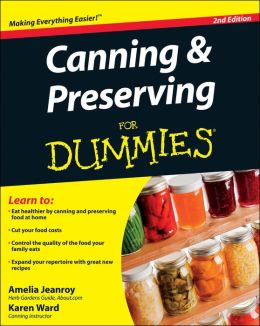
Canning & Preserving For Dummies

Canning and Preserving for Dummies
Image credit: Barnes and Noble
Not just for Dummies!

This is the first book about canning that I bought. I like the For Dummies books because they assume that you are new to a subject and really don't know anything about it. I'll admit that I love the cartoons and read the Part of Tens first! "Canning & Preserving For Dummies" is divided into five parts, each reviewed below.  Or as my Latin teacher would say, "Liber est divisa in partes quinque."

Getting Started

Part I "Getting Started" is exactly what I was looking for in a canning book. I was especially concerned about the equipment that would be needed. No problem, there's a whole chapter listing everything and anything that could possible used in canning with diagrams. I had never even seen a jar lifter or lid wand before reading this book! The authors provide an overview of the three main methods of preserving food-canning, freezing and drying. 

Canning methods to avoid are detailed. I have 1947 Ball and Kerr canning books from my mother which contain some of these methods. Even if Mom or Grandma sealed jelly jars with paraffin without any problems, botulism spores can still develop, so this technique is on the list. The USDA (United States Department of Agriculture) only approves canning by water bath canning or pressure canning. Finally, Part 1 covers how the acidity of food determines the type of canning to use and the various microorganisms that cause spoilage. I live in Denver so I really appreciated the explanation of how altitude affects canning. Methods for detecting spoiled food are described very thoroughly. I use them every time I open a jar.

Water Bath Canning

Part II "Water Bath Canning" dives right into the most common method of canning. The authors take the newbie by the hand and walk through the basic steps of canning common to all recipes. First, gather and prepare both equipment and ingredients. "Mise en place", which means getting everything ready, applies both to chefs and home foodies like me. The mysteries of filling, "debubbling", and head space are unraveled. Processing jars and testing seals are also demystified. The advice on reprocessing sealed jars boils down to don't unless every jar in the batch doesn't seal. The author's emphasis on food safety is consistent throughout the entire book. 

Now the fun begins! Charge into the "Simply Fruit" chapter for a wide variety of the classic fruits used in canning. These include apples for pie filing and applesauce, peaches, pears, and berries. Botanically, tomatoes are a fruit so recipes for tomato pieces, paste, and juice fall into this group. Next up are the jams, jellies, and marmalades that can be made from all types of fruit. The pieces of the pectin puzzle are clearly explained. Low sugar pectin is briefly mentioned but I would have liked to seen recipes using both regular and low sugar pectin. Also, there are very few classic jam or jelly recipes included.

The pickling chapter has all the recipes and techniques that one would hope. There's even a diagram about peeling and seeding a cucumber! Pickles and relish are on next year's canning list. Salsa and chutney recipes complete the water bath canning section.


Vintage Canning Books from 1947
Pressure Canning

Part III "Pressure Canning" does a very good job of taking the pressure and fear out of this technique for food preservation. Canned meat, vegetables, soups, and beans can make your pantry ready for any size of group that piles in at meal time! Choosing the right pressure canner is the most important step of the process. Multiple pictures and diagrams describe every aspect of the pressure canner. 

By the way, a pressure cooker is not the same as a pressure canner. I really appreciate the objective descriptions that don't favor any brand. Safety is strongly emphasized throughout the descriptions, which is very re-assuring. As in the water bath canning chapter, there is a step by step run through of the steps of pressure canning common to all recipes. Vegetable preserving alone is enough to get me to consider pressure canning. A cornucopia would not be enough to describe all the vegetable canning recipes in this chapter. Asparagus, corn, greens, and squash are just a few of the recipes. Particularly helpful is the list of vegetables not recommended for canning like broccoli, cucumbers, or root vegetables (parsnips, rutabagas and turnips). There are lots of illustrations of prepping vegetables for canning. 

Meat preservation by canning doesn't appeal to me. I'd just as soon freeze meat. I'm a city girl and just get meat at the grocery store as needed. However, I do see the utility of canning meat in large amounts such as after obtaining half a cow or a successful hunting or fishing trip. Basic recipes for game, beef, poultry, and fish will fill your shelves with these high protein staples. Finally, there are recipes for what the authors call combined foods. I would call them meals in a jar. Homemade baked beans, chicken stock, and spaghetti sauce with meat make quick and easy dinners on a busy day. As with all canning, preparation is the key to tasty food. I would be tempted to just eat the food after it is cooked without canning!

Freezing

There's much more to freezing than just putting food into a zippered freezer bag and into the freezer. Fresh vegetables need to be blanched, food should be wrapped to prevent freezer burn-just to mention a few techniques. Also reviewed are foods that shouldn't be frozen such as dairy and egg products (except butter). Choosing the correct containment is very important whether a rigid container, freezer bag, vacuum sealing, or wrapping in butcher wrap. All foods need to be labeled and dated so that there is a good rotation old to new items. 

The authors recommend a written inventory which would probably be most useful if you use an upright or chest freezer in addition to the freezer compartment of your refrigerator. Safety is emphasized again in the best options for thawing. It's just easier for me to freeze prepared foods like soup, stews, and vegetables than to pressure can them. The authors cover a wide variety of instructions for freezing these items. Frozen fresh herbs are a very good way to save money over buying them in winter at the supermarket.

Drying and Storing

Did you know that sun drying food is the oldest method of preservation? I didn't. Successful food drying uses many of the principles as canning and freezing. Have the right tools for the job, pick high quality food, and watch for spoilage.The tools of the trade are electric dehydrators, your oven, or the sun. The sun is free but weather dependent so only a very few areas are suitable due to the need for dry
, clear weather and consistent temperatures. I would suggest checking with your local university agricultural extension for more information. You probably have an oven so there's no additional up front cost. However, the oven can't be used for anything else while food is drying. 

Purchasing an electric dehydrator may be the best option if you are going to do a lot of preserving by drying. Dried fresh fruits are probably the most popular because of their many uses-lunches, hiking, or a quick snack to keep a toddler occupied! To prevent discoloration and oxidation, fruit can be blanched or dipped in an antioxidant like citrus juice, ascorbic acid, or commercial preparations. Recipes for a wide variety of fruits are provided-apples, apricots, bananas, cherries and more. The directions for making fruit leathers, another kid favorite, are particularly easy to follow. 

Drying vegetables will assist in storing a large harvest or great sale in a small space. I'm going to try drying tomatoes next year because the canned ones are so expensive. Too many zucchini? Make zucchini chips! For a quick soup and stew mix, combine dried potatoes, carrots, peas, and onions. Dried herbs are probably the next most popular dried food. The authors describe how to air dry commonly used herbs such as dill, oregano, sage, rosemary and thyme. Sorry no parsley! The herbal tea recipes appeal to folks like me that just hate to buy anything at the grocery store if I can make it at home. 

Have a root cellar or stairs that lead from your basement directly outside? You may be able to store root vegetables (beets, carrots, onions, potatoes, turnips) this way. Food quality, containers, and safety are described, as for other preserving methods. The additional considerations of temperature and humidity are thoroughly explained. A tried and true method of preserving.


Image credit - AllPosters.com

Wednesday, March 4, 2015

Aqua Glycolic Facial Cleanser

© Donna Cook – All Rights Reserved

I have an extreme case of rosacea. My entire face turns beet red on exertion like hiking or skiing. I've been stopped numerous times because people think my blood pressure is spiking and I'm going to have a stroke.My dermatologist recommended Aqua Glycolic Facial Cleanser and Aqua Glycolic Face Cream. I think they’re both wonderful products. 

My rosacea is a full blown case. Besides the blushing and redness, I still get occasional breakouts that look like acne, even though I’m in my early 60’s. I also have thick areas known as plaques on my skin. The two most prominent are near the tip of my nose. I also have spider veins on the side of my nose. Both are very embarrassing to me. My ophthalmologist noticed the skin redness and told me that rosacea even can affect the eyes, which was very surprising. I do get an occasional sty on my lower eyelid because of the rosacea. 

There is no cure for rosacea. I’ve seen several suggested causes. One of the early suggestions was a skin infection caused by Helicobactor pylori, the bug implicated in gastric ulcers. I was prescribed a course of antibiotics, but stopped taking them after a month. They really didn’t help my specific case and I didn’t want to be on antibiotics long term. 

As you may know, the skin has its own natural population of flora and fauna. As absolutely creepy as is it sounds, a mite called Demodex folliculorum normally lives in the sweat and oil glands of the skin. According to rosacea.org, the mite’s gut contains Bacillus oleronius which has been linked to rosacea outbreaks. 


I’ve seen all sorts of treatments on the Internet. Some articles recommend low dose long term antibiotics. Others suggest “natural treatments” like apple cider vinegar and tea tree oil. I tend to stick to modern Western medicine so I use a high SPF sunscreen out doors and exfoliate my skin with over the counter glycolic acid product, Aqua Glycolic. 

This is a non prescription product. I’ve noticed that drug stores may not stock it with skin care products or behind the pharmacy counter or special order. Buying online is the easiest way. Here's what I like about Aqua Glycolic:
  • Lasts a long time. 
  • Don’t need to use very much, one or two pumps.
  • Cool soothing cream, doesn’t really lather.
  • My rosacea is greatly minimized when I use it regularly.
  • Does not dry out my skin.
  • No prescription needed, buy it any drugstore.
  • Gently exfoliates and skin is very smooth.
  • The label says that it can be used for shaving and I can see where it would be good to use. Personally, I prefer gels that lather up a lot rather than a smooth liquid.
  • Aqua Glycolic on a pedicure brush helps to exfoliate my heels. It's so much nicer than a pumice stone, nail sanding blocks or a metal rasp.
My dermatologist actually told me that I have "very very sensitive" skin. Aqua Glycolic only produces a slight tingling if I have not used it for a while. I had stopped using it for about a year and the rosacea came back with a vengeance. I learned my lesson and won't stop using it again!

According to their Web site, "Glycolic acids are natural anti-aging compounds found in sugar cane that help remove dead skin cells and moisturize your skin." I had oily skin until menopause and then dried up like a desert. Any type of soap or cleanser made my skin feel dry and itchy. I was afraid that Aqua Glycolic would dry my skin even more. Boy, was I wrong! It really does moisturize very well. 

Aqua Glycolic Facial Cleanser comes in a plastic six ounce pump bottle that I just leave in the shower. A single bottle is about $18.00 and triple packs are about $40.00, which as a savings of about $4.50 per bottle. I also use Aqua Glycolic Face Cream to give rosacea a one-two punch. Aqua Glycolic Face Cream is packaged in a two ounce jar for about $24.00. They also offer Toner, Shampoo and Body Lotion which I want to try. Those prices range from about $16,00 to $25.00. These prices are mid to low compared with other glycolic acid cleansers. Of course, soap and water is the cheapest way to clean your skin. However, soap makes my skin very flaky and aggravates the rosacea.

Recently, a physician did a double take when she looked at me and then my birth date. She said that I looked about ten years younger than my actual age. Of course, picking the right parents helps, but I think that using Aqua Glycolic Facial Cleanser and Face Cream regularly is a factor. 

I am so glad my dermatologist recommended an over the counter skin care product, not a prescription item. Aqua Glycolic Facial Cleanser and Face Cream work terrifically for me. 
Image Credit: Allposters.com

Vizio 40 inch Smart LED HDTV


Image credit: Best Buy
I love my new Vizio TV! The picture is crystal clear, I can watch Netflix, YouTube and it's HD. The price is very affordable. The set is lightweight and a good quality. The setup was very easy and the customer service is superb.

Tale of TV Woe

My TV technology was in a sorry state of affairs. I had bought one of the first HDTV's twelve years ago. It was a monstrous 400 pound gorilla that stopped working after 7 years and was too heavy to move to a repair shop. I was watching Netflix on my laptop because there can be 150 cable channels with nothing intelligent on. My back up TV was a 19-inch screen, over 25 years old, and buzzed with any crawls like on CNN. The backup to the backup was a 13 year old 10 inch TV with built in VCR.

When I could afford a new TV. I went to the Best Buy Web site and made a preliminary choice. I wanted to talk to a live person and make sure that I bought the most up to date TV in my price range. I'm glad that I did because I found out that the refresh rate on the one had chosen online was too slow. As I was talking to the sales person, I saw a TV on the wall whose picture quality stood out from all the other TV's on display. I know that it may have been the settings but the image was truly striking in comparison to the other TVs.

Good Points in Bullet Points
  • Picture clarity stood out from all others on the display wall at Best Buy.
  • Well priced compared to better known brands. 
  • Only weighs 17.2 pounds with the stand and I can move the TV very easily.
  • The initial setup was very easy. The built in Wi-Fi practically installed itself.
  • USA based customer service has been very helpful on several occasions (see below).
  • ENERGY STAR Certified.
  • Has many of the same features as more expensive models and costs less.
Terrific Customer Service

I did have a little bit of trouble getting the cable connection to work. The TV was saying "No signal." I knew that it was probably just a setting. I checked the cable connections, turned both the TV and cable box off and on. I gave in and finally called Tech Support. I was totally surprised that my call was answered almost immediately. The USA based customer service representative was very patient and we fixed the settings in less than five minutes. 

Some of the specs

The Vizio 40 inch Smart LED HDTV only weighs 17.2 pounds with the stand so I can move the TV very easily. Customer Service is based in the USA. Vizio is headquartered in California and the set was manufactured in Asia, like most electronics. The last list price I saw on Best Buy was $369.99, For you technical types, it has a 40” diagonal screen, LED displays, 1080p resolution with 120HZ refresh rate, 3 HDMI inputs and 1 USB input. The only downside is the remote control seems a bit flimsy but it can be easily replaced.

Similar Vizio LED HDTV's come in sizes ranging from 23" priced at about $168 to a monster 80" at about $3200. In the October 2014 issue of "Good Housekeeping," the 60" priced at about priced at about $800 was listed as a "Great Value." 

I am very pleased with this TV. The price is very affordable. The set is lightweight and a good quality. The setup was very easy and the customer service is superb. I had to get moving company to take the 400 lb Panasonic to the recycling center. Good riddance!


Image credit: Allposters.com